Skip to content

By December, a small Alaskan town was almost completely covered in snow. Tall evergreen trees lined the roads, their branches heavy with white, while mountains rose in the distance beneath a pale gray sky. Christmas lights glowed from nearly every house and storefront, creating warm spots of color against the long, cold evenings.
The government-run hospital sat just outside the center of the community. Its entrance was decorated with a wreath and strings of white Christmas lights, and a Christmas tree stood in the lobby beside a small table of hot cocoa for hospital staff.

But inside her office, Dr. Claire Bennett, the hospital director, wasn’t thinking about Christmas. She was staring at a wastewater report.
The hospital used approximately 40,000 gallons of water every day, about 150 cubic meters. That water supported everything from patient care and sanitation to laundry, kitchens, laboratories, and daily operations. Once used, however, it became wastewater that needed to be treated reliably before discharge.
Claire had been increasingly concerned about the reliability of the treatment process during the Alaskan winter. The hospital was in a relatively remote area, and severe weather could make transportation difficult. A snowstorm could close roads for hours or even days.
The last thing she wanted was for the hospital’s wastewater treatment system to depend on a delivery arriving through a blizzard.
“We need something more reliable,” she said quietly.
That evening, Claire stayed late at the hospital. Most of the administrative offices were dark, but the Christmas lights in the lobby were still glowing. She made herself a cup of hot chocolate and returned to her desk to research onsite wastewater treatment systems.
One company kept appearing in her search:
BioMicrobics.
Claire opened the BioMicrobics website and began reading about its wastewater treatment technologies. She came across MyFAST®, a larger FAST system designed for onsite wastewater flows between 10,000 and 160,000 gallons per day.
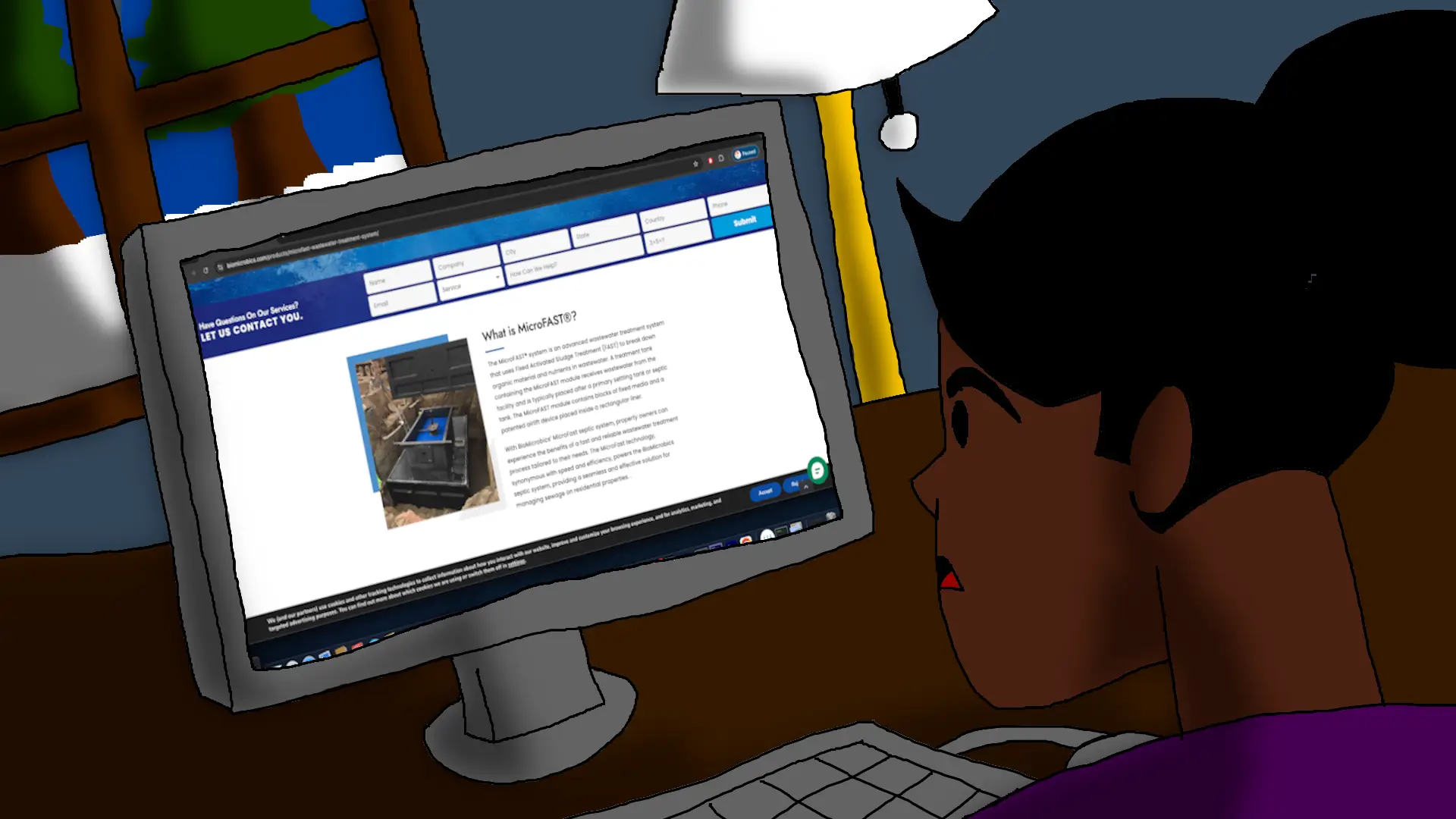
The hospital’s 40,000-gallon-per-day flow fell comfortably within that range.
MyFAST uses Fixed Activated Sludge Treatment (FAST) to biologically treat wastewater. Its treatment train can include a primary clarification area, a main biological treatment tank containing fixed-film treatment modules, and an optional Biosolids Management System (BMS) for sludge storage and digestion. An Aeration Management System (AMS) with LIXOR® pre-aeration devices could also be incorporated.
Claire looked again at the hospital’s wastewater report.
“This might actually fit,” she said.
But treatment was only part of the challenge. The hospital also needed a dependable disinfection process.
As she continued researching, Claire came across SciCHLOR, an onsite sodium hypochlorite generation system. Instead of depending on deliveries of bulk liquid bleach, SciCHLOR could generate a low-strength sodium hypochlorite solution onsite using salt, water, and electricity.
Claire immediately thought about the hospital’s remote location.
“MyFAST for wastewater treatment. SciCHLOR for disinfection.”
She still needed to determine whether the two technologies could work together for the hospital’s application. She noticed that BioMicrobics worked with trusted advisors who could help evaluate specific projects.
One name stood out:
Aerobe.
The next morning, Claire contacted Aerobe and explained the hospital’s situation.
“We’re a government-run hospital in a remote part of Alaska,” she said. “We’re dealing with approximately 40,000 gallons of wastewater per day. Our biggest challenge is that our winters are extremely cold, and transportation can become difficult.”
She explained that the hospital wanted a reliable onsite treatment solution with minimal dependence on chemical deliveries.
“I found MyFAST and SciCHLOR while researching BioMicrobics,” Claire said. “I’m wondering if they could work together for an application like ours.”
Aerobe listened carefully.
“Let’s take a closer look at what the hospital needs.”
They reviewed the hospital’s flow, operating conditions, remote location, and need for continuous treatment with minimal operator intervention.
Aerobe explained that MyFAST could provide the biological treatment stage. The first compartment could function as a primary clarifier, while the AMS Zone could incorporate LIXOR pre-aeration devices. Wastewater would then enter the main treatment tank, where fixed-film modules would provide a surface for microorganisms to grow and support biological treatment.
“And the biosolids?” Claire asked.
“The BMS Zone can provide storage and digestion for wasted biosolids from the main treatment tank,” Aerobe explained.
Claire then asked about disinfection.
Aerobe explained that SciCHLOR could generate sodium hypochlorite onsite, reducing the hospital’s dependence on deliveries and storage of bulk bleach. The system could produce approximately 0.8% sodium hypochlorite and include automated controls, monitoring, and alarms.
“So instead of waiting for a chemical delivery,” Claire said, “we’d be generating the disinfectant ourselves?”
“Exactly.”
She smiled.
“That’s exactly what I was hoping to hear.”
Over the following weeks, Claire and the hospital’s facilities team worked with Aerobe to develop the treatment approach.
The team also considered the challenges of installing and operating wastewater treatment equipment in Alaska’s extreme winter climate. To help protect the system from harsh weather and make maintenance more manageable, they discussed housing the MyFAST and SciCHLOR equipment in an economical, enclosed building located behind the hospital. This approach would provide a dedicated space for the treatment equipment while helping the hospital prepare for freezing temperatures, snow, and difficult winter conditions.
Wastewater would enter the MyFAST system, where solids would first be separated before the flow moved through the AMS Zone and LIXOR pre-aeration stage. The main treatment tank would use fixed-film modules and continuous aeration to support biological treatment, while the BMS Zone would provide biosolids storage and digestion.
After biological treatment, the wastewater would move to the disinfection stage.
That’s where SciCHLOR would come in.
Instead of storing large quantities of purchased liquid bleach, the hospital could generate its sodium hypochlorite onsite from salt, water, and electricity.
For Claire, the approach offered something the hospital needed most: greater control and less dependence on winter chemical deliveries.
By the time the system was operating, Christmas was just around the corner. Snow covered the rooftops and pine trees, while strings of Christmas lights illuminated porches and storefronts.
Inside the hospital, Claire walked through the lobby and watched a group of nurses decorating the Christmas tree. For months, she had worried about what the winter might bring.
Now, she felt prepared.
Behind the hospital, MyFAST was supporting the wastewater treatment process, while SciCHLOR provided onsite sodium hypochlorite generation for disinfection. Together, the systems gave the hospital a treatment approach designed around its flow, remote location, and challenging winter conditions.
That night, Claire stood by the lobby window with a cup of hot chocolate in her hands. A little boy wearing a red scarf pulled his sled past the hospital entrance, laughing as his father followed behind him.

Claire smiled. The hospital couldn’t control the weather. But it could prepare for it.
And sometimes, in a place like Alaska, reliability meant being ready before the storm arrived.